
TI Plumbing Guide for General Contractors.
Everything a GC needs to know about plumbing scope during tenant improvement projects — licensing requirements, permit triggers, rough-in timelines, and coordination points that keep your project on schedule.
WHY TI PLUMBING GETS MISSED
Plumbing Is the Scope That Surprises GCs on TI Projects.
Most tenant improvement projects start with a space plan and a lease requirement. The architect draws the new layout, the GC prices demo, framing, electrical, HVAC, and finishes. Plumbing gets a line item — sometimes just a plug number — and the assumption is that it will be minor. Move a sink, add a drain, connect a dishwasher. Simple.
Then the plans go to permitting and the plumbing scope expands. The new restroom location requires a slab cut. The break room sink needs a new water and waste line run 40 feet from the nearest stack. The tenant wants a coffee bar with a grease interceptor. The existing backflow assembly doesn't cover the new use — now the water district requires an upgrade before they will approve the meter change.
This happens because plumbing in TI work is governed by California licensing law, local building codes, and water district requirements that most GCs encounter only occasionally. This guide covers what triggers the need for a licensed plumber, what requires a permit, and how to integrate plumbing milestones into your TI schedule so nothing gets missed, delayed, or red-tagged.
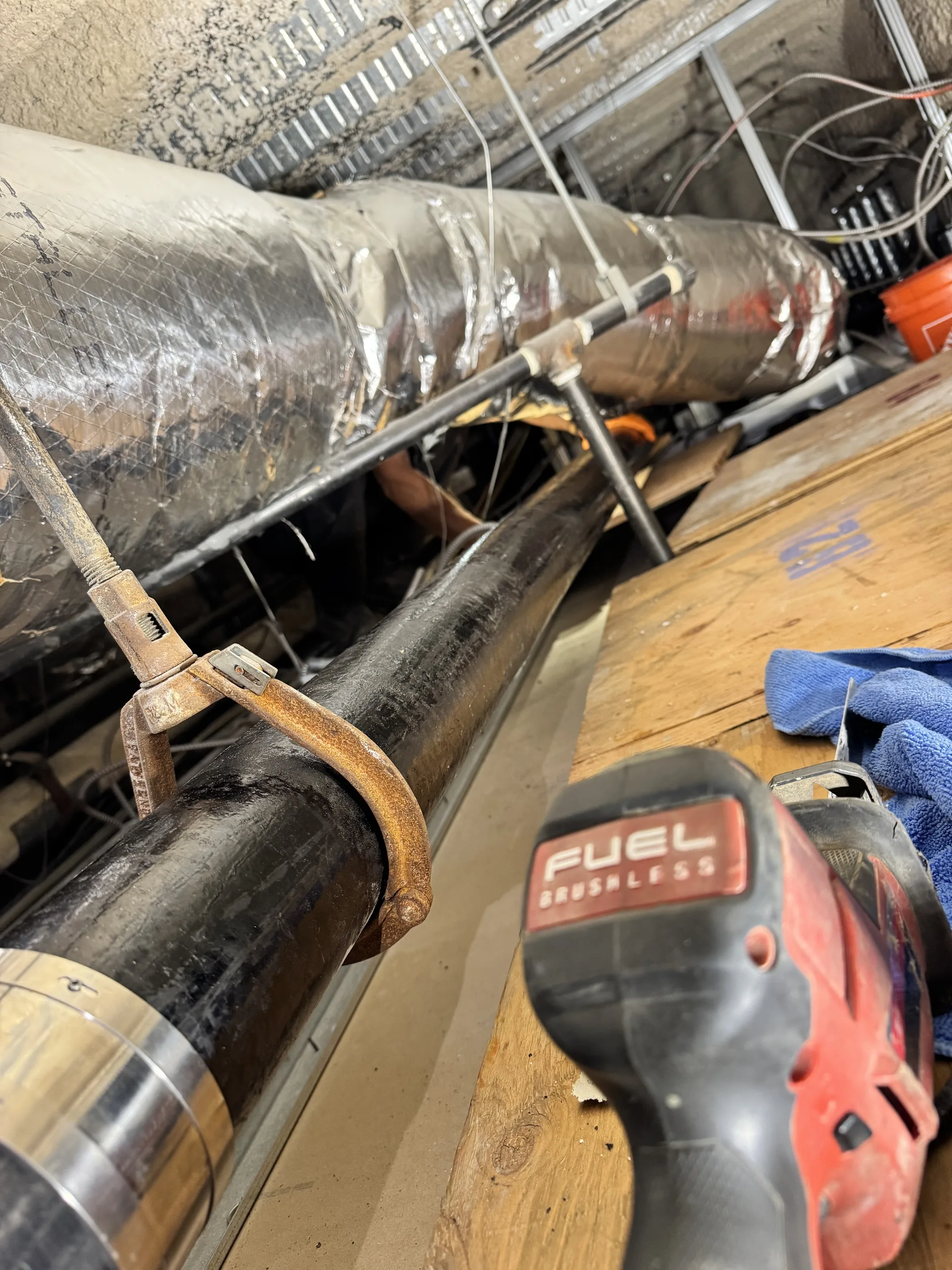
CALIFORNIA C-36 LICENSE REQUIREMENT
When a Licensed Plumber Is Required on a TI Project.
California law is clear: any work on water supply, drain-waste-vent (DWV), or gas piping systems requires a C-36 licensed plumbing contractor. This is not optional, and it is not waivable by the GC's B license.
The C-36 classification covers all plumbing work as defined in California Business & Professions Code Section 7058. This includes installation, maintenance, and repair of piping systems for water supply, waste and vent, gas, and related fixtures. A general contractor holding a B license can self-perform many trades, but plumbing is not one of them unless the GC also holds a C-36.
The threshold is lower than most GCs expect. Moving a sink six inches still requires a permit. Adding a drinking fountain to a break room requires a plumber. Connecting a gas line to a tenant's kitchen equipment requires a plumber. Even capping an abandoned line during demo — if it is a water, waste, or gas line — technically requires a C-36.
The risk of non-compliance is real. If an unlicensed worker performs plumbing work and a failure occurs — a leak, a cross-connection, a gas leak — the GC carries the liability. The building department can issue a stop-work order. The CSLB (Contractors State License Board) can pursue enforcement. And the tenant's certificate of occupancy can be held until the work is corrected by a licensed contractor and re-inspected.
Bottom line: If the TI scope touches any pipe that carries water, waste, or gas, a C-36 licensed plumber needs to be on the job. Build that into your bid from day one — not as an afterthought during construction.
COMMON TI PLUMBING SCOPE ITEMS
What Typically Shows Up in a TI Plumbing Package.
Every TI project is different, but these are the plumbing scope items we see most often on commercial buildouts across Southern California. If any of these are in your project, you need a C-36 sub on your team.
Restrooms
Adding or Relocating Restrooms
New tenant footprint often requires adding, expanding, or relocating restrooms to meet occupancy and ADA requirements. Includes water supply, DWV, floor drains, and fixture installation. Usually the largest plumbing scope item in a TI project.
Break Room & Kitchenette
Break Room Sinks & Dishwashers
Hot and cold water supply, waste line, and sometimes a dedicated shut-off. If the break room is not near an existing stack, the waste line run can be the longest single pipe run in the TI scope — requiring slab penetration or above-ceiling routing.
Drinking Fountains
Drinking Fountains & Bottle Fillers
Required by code based on occupancy. Water supply and drain connection, typically on an interior wall. ADA-compliant fountain height and approach clearances must be coordinated with the architect before rough-in.
Food Service
Grease Traps & Interceptors
Any food service tenant — restaurant, cafe, commercial kitchen, food court — requires a grease interceptor before waste connects to the building sewer. Sizing depends on fixture count and flow rate. Often requires a separate exterior interceptor with sampling access.
Backflow Prevention
Backflow Devices & RPZ Assemblies
New use types (food service, medical, dental, laboratory) may require upgraded backflow protection at the meter. The local water district — not just the building department — must approve the assembly type and installation. Lead times on RPZ assemblies can be 2–4 weeks.
Floor Drains
Floor Drains & Area Drains
Required in restrooms, kitchens, mechanical rooms, and any area where equipment is water-cooled or regularly washed down. Floor drains require slab cuts and tie-ins to the building DWV system. Trap primers may be required to prevent sewer gas from dry traps.
Gas Connections
Gas Lines for Kitchen Equipment
Commercial ranges, ovens, fryers, and water heaters require gas piping sized to the BTU load of all connected appliances. Gas work requires a separate gas permit, a pressure test before concealment, and an air test before final. Must be performed by a C-36 licensed plumber.
Specialty
Medical Gas, Lab Waste & Special Systems
Dental suites need vacuum and compressed air lines. Medical offices may need medical gas. Labs need acid waste piping. These specialty systems have their own code requirements and often require a plumber with specific experience beyond standard commercial work.
PERMIT TRIGGERS IN TI PLUMBING
When a Plumbing Permit Is Required — and What the Inspector Checks.
In California, a plumbing permit is required any time you install, relocate, replace, or alter any plumbing fixture, piping, or gas line. The only exception is minor repairs that do not alter the system — replacing a faucet cartridge, for example. Everything else needs a permit.
| Scope Item | Permit Required? | Inspection Type | Common Fail Points |
|---|---|---|---|
| New restroom (fixtures + piping) | Yes — plumbing permit | Underground, rough-in, top-out, final | Incorrect venting, missing cleanouts, slope violations |
| Relocating a sink (any distance) | Yes — plumbing permit | Rough-in, final | Inadequate vent, improper trap arm length |
| Adding a floor drain | Yes — plumbing permit | Underground, rough-in, final | Missing trap primer, incorrect slope to drain |
| Grease interceptor installation | Yes — plumbing + possibly encroachment | Underground, final, district inspection | Undersized unit, no sampling port, wrong location |
| Gas line for kitchen equipment | Yes — separate gas permit | Rough-in pressure test, final air test | Undersized pipe for BTU load, missing drip legs, no seismic connector |
| Backflow assembly upgrade | Yes — plumbing permit + water district | Installation, certification test | Wrong assembly type for hazard level, insufficient clearances |
| Water heater replacement | Yes — plumbing permit | Final | Missing expansion tank, incorrect T&P discharge, seismic strapping |
| Capping abandoned lines | Depends on jurisdiction | Rough-in or final | Open or improperly capped lines behind walls |
Rough-in vs. final inspection: Most TI plumbing work requires at least two inspections. The rough-in inspection happens after piping is installed but before walls are closed — the inspector needs to see the pipe routing, venting, slope, connections, and support. The final inspection happens after fixtures are installed and the system is pressurized. If you close walls before the rough-in inspection, the inspector will require you to open them.
Underground inspections are required when slab work is involved — new floor drains, restroom relocations, or any piping below the concrete floor. The inspector must see the trenching, pipe, bedding, and connections before concrete is poured back. Missing an underground inspection can mean breaking out brand-new concrete to expose the work.
GC / PLUMBER COORDINATION POINTS
Where TI Projects Go Sideways Without Coordination.
Plumbing on a TI project touches every other trade. These are the coordination points that cause schedule delays, change orders, and re-work when they are not addressed before construction starts.
Above-Ceiling Coordination
Plumbing waste and vent lines, HVAC ductwork, electrical conduit, and fire sprinkler heads all compete for the same ceiling cavity. A plumbing waste line has a mandatory slope — it cannot be moved up or down to accommodate ductwork. Route plumbing first, then coordinate HVAC and electrical around it. A ceiling coordination drawing before rough-in prevents field conflicts.
Slab Penetrations
Any new floor drain, restroom relocation, or below-grade waste line requires cutting the concrete slab. This must happen early in the schedule — before framing begins over the affected area. The GC needs to coordinate saw-cutting, excavation, backfill, and re-pour with the plumber's underground schedule and the building inspector's availability.
Fire Stopping
Every pipe that penetrates a rated wall or floor assembly requires fire stopping — UL-listed materials installed per the tested assembly. This is the GC's responsibility to coordinate, but the plumber needs to leave sufficient clearance around penetrations for the fire stop installer. Missed fire stopping is the number one item flagged on TI final inspections.
Fixture Rough Timing
Plumbing rough-in must happen after framing but before drywall. If the framer closes walls before the plumber roughs in the supply and waste lines, the walls come back open. The GC's schedule must sequence framing, plumbing rough, inspection, then close-up — with no gap for other trades to block access.
Hot Work Permits
Soldering copper, brazing, or using a torch for any plumbing connection in an occupied building or a space with active fire suppression requires a hot work permit. The GC must coordinate with building management, the fire watch requirement, and potentially the fire alarm company to impair the zone during the work. Skipping this step can trigger a building-wide alarm evacuation.
Water & Gas Shutdowns
Tying new plumbing into existing building systems requires shutdowns. In a multi-tenant building, this means coordinating with the property manager, notifying adjacent tenants, and scheduling the shutdown during off-hours. A 30-minute tie-in can require a week of coordination. Build this lead time into the schedule — not the day before the plumber needs access.
TIMELINE INTEGRATION
Plumbing Milestones in a Typical TI Project Schedule.
Plumbing is not a single line item on a TI schedule. It touches the project at six distinct phases. Missing any one of them creates a cascading delay across all downstream trades.
-
Underground / Slab Work
New below-grade waste lines, floor drains, and slab penetrations. Happens during or immediately after demo, before any framing begins over the affected areas. Requires underground inspection before backfill and concrete pour.
Typical duration: 2–5 days depending on scope. Inspector hold point before pour.
-
Rough-In (In-Wall)
Supply and waste piping installed inside walls and above ceilings after framing is complete. All pipes are run to fixture locations, capped, and pressure-tested. Requires rough-in inspection before drywall.
Typical duration: 3–7 days. Must be complete before insulation or drywall.
-
Top-Out
Vent piping through the roof or tied into the building vent system. Roof penetrations require coordination with the roofing contractor for flashing and waterproofing. Top-out may be inspected as part of rough-in or separately depending on jurisdiction.
Typical duration: 1–2 days. Coordinate with roofer for flashing.
-
Trim / Fixture Installation
Toilets, sinks, faucets, drinking fountains, dishwashers, and other fixtures installed after floors and walls are finished. This is the most visible phase — and the most schedule-sensitive because it cannot start until the space is painted and floored.
Typical duration: 2–4 days. Sequence after paint and floor finish.
-
Testing & Startup
System pressurized, all fixtures tested for operation and leaks, gas lines pressure-tested, water heaters fired, backflow assemblies tested and certified. Any issues found here must be corrected before final inspection.
Typical duration: 1–2 days. Backflow certification may require separate scheduling with the water district.
-
Final Inspection & Closeout
Building inspector verifies all fixtures, connections, and systems match the approved plans. Gas test results reviewed. Backflow certification submitted. Any deficiencies corrected and re-inspected. Once plumbing final passes, it clears the way for the certificate of occupancy.
Schedule 3–5 business days for inspector availability. Budget 1–2 correction days if needed.