
Why Your Commercial Building Has Slow Drains — and Why They Keep Coming Back.
A single slow sink is a nuisance. Building-wide drainage problems are a liability. When drains back up across multiple fixtures or the same line clogs within weeks of being cleared, the problem is almost never what’s sitting in the trap — it’s what’s happening deeper in the system. Grease accumulation, corroded cast iron, root intrusion, bellied pipe sections, or a compromised main sewer line. Here are seven root causes, how to tell which one you’re dealing with, and what each fix actually involves.
WHAT YOU'RE EXPERIENCING
One Slow Drain Is a Clog. Multiple Slow Drains Are a System Problem.
Drain problems in commercial buildings fall into three patterns. A single slow fixture is usually a local blockage you can address at the fixture level. But when drainage is slow across an entire floor, an entire building, or when the same drain backs up again within weeks of being cleared — the problem is structural, and clearing the line again won’t fix it. The pattern tells you where to look.
SYMPTOM PATTERN
Single-Fixture Slow Drain
One sink, one toilet, or one floor drain is slow or backing up. Every other fixture in the building drains normally. Points to a local blockage in the branch line serving that fixture — grease in a kitchen line, hair and soap in a lavatory drain, or debris in a floor drain trap. Usually resolved with snaking or hydro-jetting the individual branch line.
SYMPTOM PATTERN
Building-Wide Slow Drainage
Multiple fixtures across multiple floors are draining slowly — sinks gurgling, toilets sluggish, floor drains pooling. The problem is systemic, not local. Points to a main sewer line restriction, widespread cast iron corrosion reducing pipe diameter, or a collapsed section downstream where all branch lines converge.
SYMPTOM PATTERN
Recurring Backups After Clearing
The drain gets snaked, flows fine for two to six weeks, then backs up again in the same location. The cable cleared a symptom, not the cause. Points to a structural issue — root intrusion that regrows, a bellied pipe section that collects debris, cast iron corrosion that re-accumulates scale, or a partially collapsed line that narrows flow permanently.
DIAGNOSIS — SEVEN ROOT CAUSES
Seven Causes of Drain Problems in Commercial Buildings.
Every recurring drain complaint we diagnose traces back to one of these seven causes. The first six are building-side problems a commercial plumber can fix. The seventh — improper venting — is a code and design issue that requires inspection before correction. Knowing which cause you’re dealing with determines whether the fix is a $400 hydro-jet or a $40,000 main line replacement.
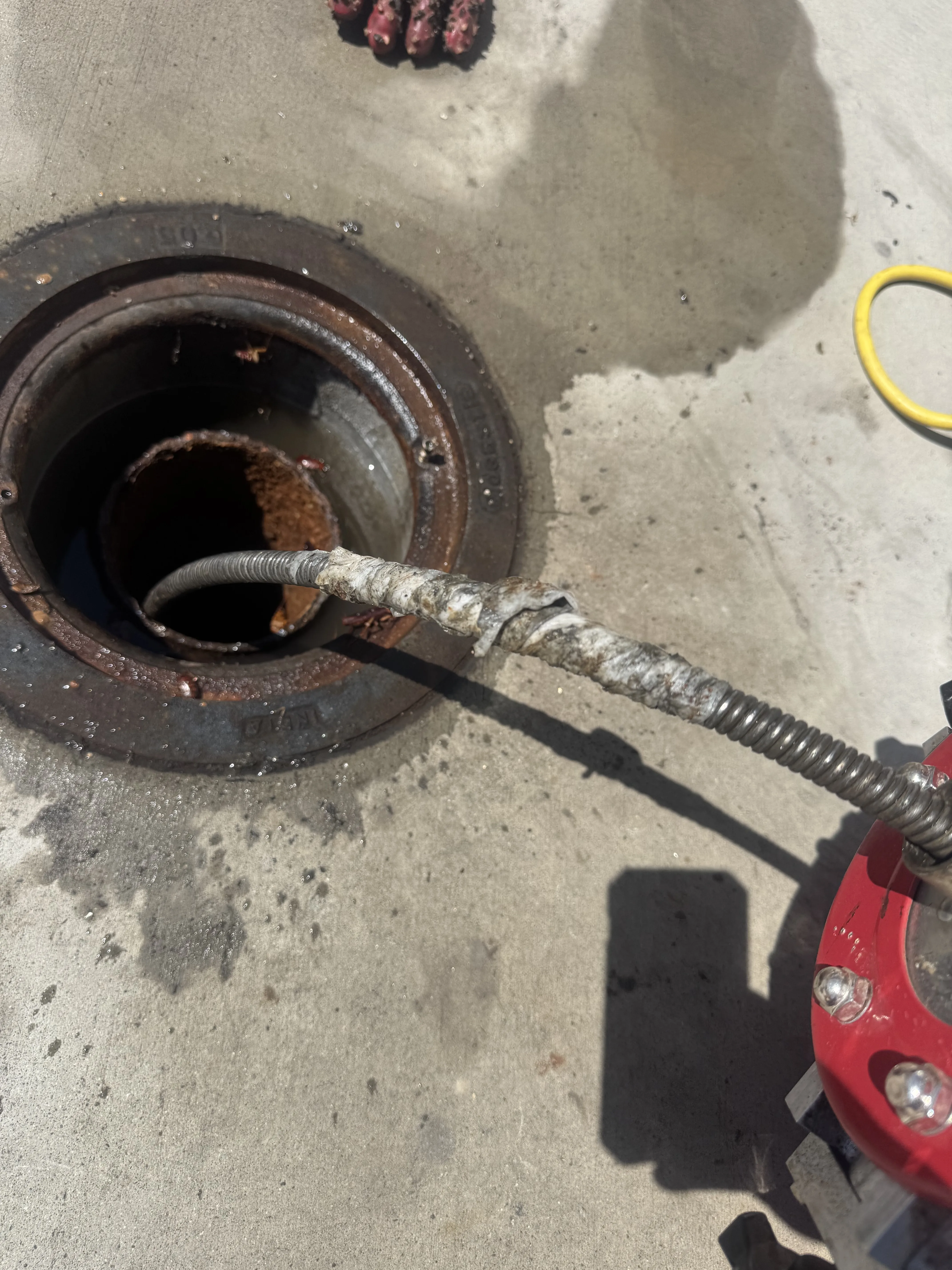
Grease Accumulation
Most Common in Food Service BuildingsGrease doesn’t dissolve in hot water — it cools and solidifies inside drain lines. In restaurants, commissary kitchens, food courts, and any commercial building with food prep, grease accumulates in branch lines and main sewer lines over time. The buildup narrows the pipe, slows flow, and eventually causes full blockages. If your building has food service tenants and drains are slow building-wide, grease is the first thing to investigate. California FOG (Fats, Oils & Grease) regulations require interceptors for commercial food service — but undersized or poorly maintained traps let grease pass through to the building’s sewer system.
Most likely if: Building has restaurant, kitchen, or food prep tenants. Drain problems are worst in lines serving kitchen areas. Grease trap hasn’t been serviced in 90+ days.
What the fix involves: Grease trap inspection and service, hydro-jetting of affected drain lines, FOG compliance review. Grease Trap Service →
Cast Iron Corrosion & Scale Buildup
Most Common in Pre-1980 BuildingsCast iron drain, waste, and vent (DWV) pipe was the standard for commercial buildings constructed before 1980. Over 40–60 years, the interior of cast iron corrodes and develops thick scale deposits that reduce the pipe’s internal diameter — sometimes from 4″ down to less than 2″. The restriction is progressive. Drains get gradually slower over years, not overnight. When you snake a corroded cast iron line, the cable scrapes a temporary channel through the scale, but the corrosion re-accumulates within weeks. That’s why the backup keeps coming back.
Most likely if: Building was constructed before 1985. Drains have gotten progressively slower over years. Snaking provides temporary relief but the problem returns within 2–6 weeks. Camera inspection shows heavy tuberculation, channeling, or wall loss.
What the fix involves: Sewer camera inspection to assess pipe condition, followed by partial or full DWV system replacement. Repiping & Pipe Replacement →
Root Intrusion
Check If Landscaping Near Sewer LinesTree and shrub roots seek moisture. When a sewer line develops a crack or a joint separates, roots find the opening and grow into the pipe. Inside the line, root masses trap debris and grease, creating progressively worse blockages. Snaking cuts through the roots temporarily, but they grow back — typically within 30–90 days in Southern California’s climate. If your building has mature trees or heavy landscaping near the sewer lateral, and the same line backs up repeatedly after clearing, root intrusion is a strong possibility.
Most likely if: Mature trees or dense landscaping sit within 10 feet of the sewer lateral. Backups recur 1–3 months after each clearing. Camera inspection shows root masses at joints.
What the fix involves: Camera inspection to locate root entry points, hydro-jetting to clear root mass, then root barrier or pipe repair/replacement at affected joints. Sewer Camera Inspection →
Bellied or Sagging Pipe Sections
Check in Settling or Older BuildingsA “belly” is a section of pipe that has settled or sagged below the grade of the rest of the line. Water and waste collect in the low point instead of flowing through to the main. The standing water in the belly traps solids, grease, and debris, creating a chronic blockage point. Bellies are caused by soil settlement, inadequate bedding during original installation, or ground movement. They’re invisible from above ground — the only way to confirm a belly is with a sewer camera inspection. Bellied pipes cannot be fixed by snaking or jetting; the pipe section must be excavated and re-graded or replaced.
Most likely if: Building has experienced foundation settlement or ground movement. The same section of pipe backs up repeatedly. Camera inspection shows standing water in a low section that doesn’t drain.
What the fix involves: Camera inspection to locate and measure the belly, then excavation and pipe replacement or re-grading of the affected section. Sewer Camera Inspection →
Undersized or Shared Drain Lines
Check After Tenant Buildout or TI WorkWhen a building undergoes tenant improvement work — adding restrooms, break rooms, or converting space to food service — the new fixtures sometimes connect to existing drain lines that weren’t sized for the additional load. A 3″ line originally serving two restrooms may now be serving four. The pipe doesn’t have the capacity to handle peak flow, so drains are slow during high-use periods and back up when multiple fixtures discharge simultaneously. This is a design problem, not a blockage — snaking won’t solve it.
Most likely if: Drain problems started after a tenant buildout or renovation. Backups happen during peak usage (mornings, lunch rush). Multiple new fixtures were connected to existing drain lines during TI work.
What the fix involves: Assessment of drain line sizing relative to fixture count, potential rerouting or upsizing of shared drain lines. Drain Cleaning & Assessment →
Blocked or Collapsed Main Sewer Line
Emergency — Immediate Action RequiredA full blockage or collapse of the main sewer line is the most severe cause on this list. When the main line is blocked, every drain in the building is affected — and wastewater has nowhere to go but back up through floor drains, toilets, and the lowest fixtures in the building. A collapsed line means the pipe has physically failed — crushed by soil pressure, deteriorated beyond structural integrity, or offset at joints. This is an emergency. Sewage backups create health hazards, code violations, and tenant displacement. If every drain in the building has stopped simultaneously, this is the most likely cause.
Most likely if: All drains in the building have stopped or are backing up simultaneously. Sewage is surfacing through floor drains or cleanouts. The building is pre-1980 with original cast iron sewer lines.
What the fix involves: Emergency response to mitigate the backup, camera inspection to locate the failure point, then excavation and main line replacement. Emergency Plumbing →
Improper Venting
Rule This Out If Drains GurgleEvery drain in a commercial building connects to a vent system that allows air to enter the drain pipes as water flows through them. Without proper venting, draining water creates a vacuum that pulls water out of nearby P-traps (causing sewer odor) and slows drainage. Symptoms of a vent problem include gurgling sounds when fixtures drain, slow drainage that improves when you open a nearby cleanout, and intermittent sewer odor. Vent problems are most common after renovation work that disconnected or undersized vent connections, or when vent stacks on the roof become blocked by debris, bird nests, or roofing materials.
Most likely if: Drains gurgle when other nearby fixtures are used. Drainage is slow but improves if a cleanout cap is removed (allowing air into the system). Drain problems started after renovation or re-roofing work. Sewer odor accompanies the slow drainage.
What to do: Vent issues require inspection of the vent stack from the roof and verification of vent connections at each fixture branch. A camera inspection of the DWV system can identify blocked or disconnected vents.
On-Site in 2 Hours. That Is Our Standard.
Commercial emergencies do not wait for business hours. Our Priority 1 (P1) SLA targets a 2-hour response during business hours and a 2-hour dispatch for after-hours crises — across Orange County, LA, Riverside, San Bernardino, and San Diego. One call. We handle the rest.
2-Hour Response — (714) 632-0170