
Hydro-Jetting vs. Drain Snaking vs. Chemical Cleaners: What Actually Works.
Three methods, one drain line. They don't do the same thing — and using the wrong one for the situation means you'll be calling again in two weeks. Here's the actual difference.
THE DISTINCTION THAT MATTERS MOST
A cleared drain
and a clean drain
are not the same.
When a drain backs up and a cable snake is run through it, the drain works again. Water flows. The tenant stops calling. The problem appears solved.
But the grease that coated the pipe wall is still there. The scale buildup that narrowed the interior diameter is still there. A channel was punched through the blockage — and the conditions that created it were left completely intact. In two to four weeks, the same drain backs up again.
The goal in commercial drain maintenance isn't to clear a blockage. It's to restore the pipe to near-original flow capacity — by removing what's adhered to the pipe wall, not just what's blocking the center.
That distinction determines which method is appropriate. Snaking is an emergency intervention. Hydro-jetting is a maintenance tool. Chemical cleaners are neither — and in California commercial food service, they're regulated out of use entirely.
Understanding what each method physically does — not just what it's called — is how commercial property managers stop paying for the same drain call repeatedly.
THE THREE METHODS, EXPLAINED
What Each One Actually Does Inside the Pipe.
Method 01
Mechanical Snaking
Cable Auger / Electric Eel
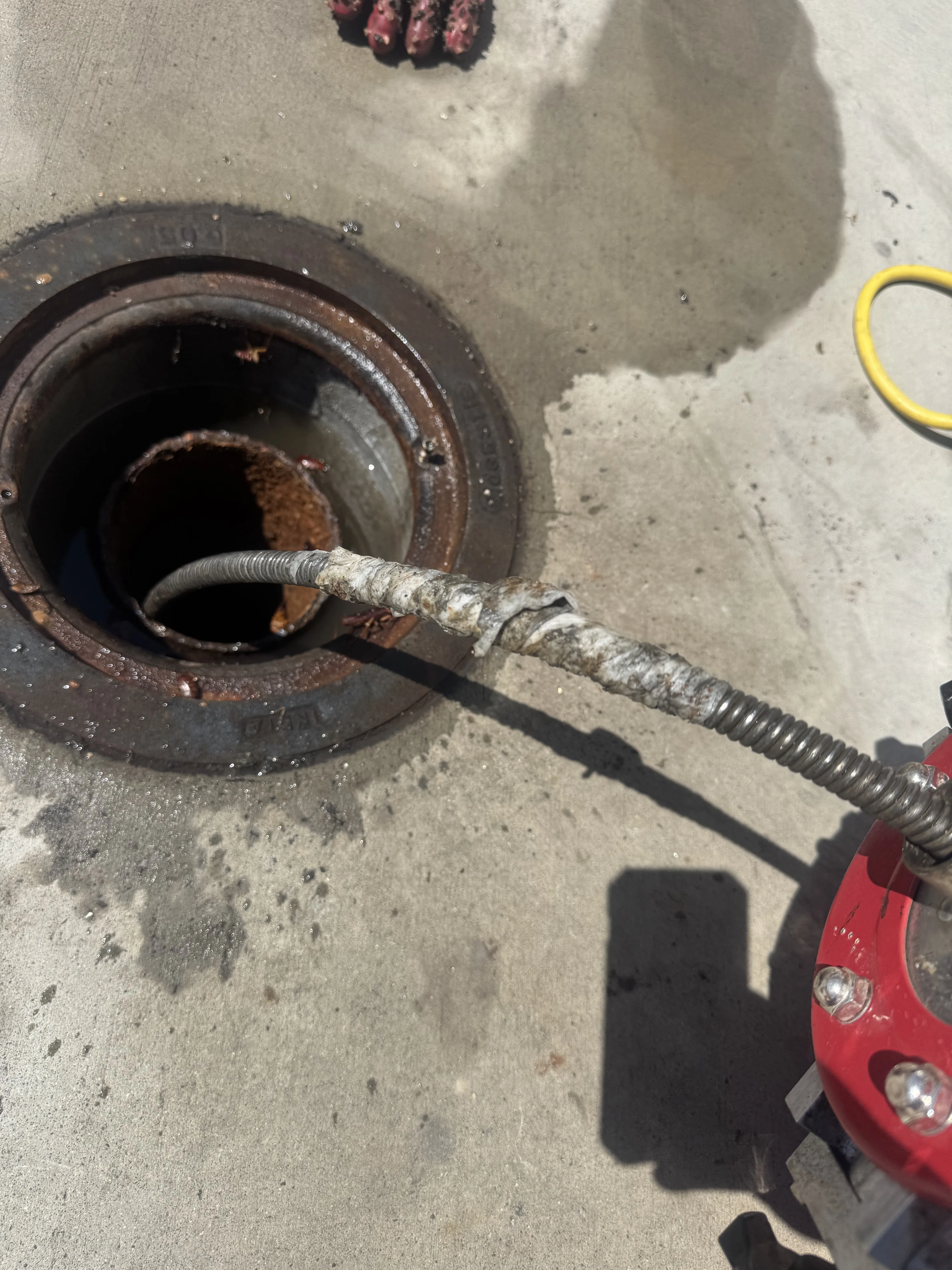
A flexible steel cable — typically ½ to 1 inch in diameter — is fed into the drain line and rotated by a motor. A cutting head at the tip breaks up or punctures through the blockage, creating a hole in the obstruction for water to pass through.
The cable works in the center of the pipe. It contacts what's blocking the flow. It does not contact the pipe wall.
What It Accomplishes
- Breaks up or removes soft blockages — toilet paper, food debris, accumulated organic material
- Cuts through or retrieves foreign objects (rags, wipes, food solids)
- Restores flow in emergency situations quickly, with minimal setup
- Low equipment overhead — available for tight access, vertical stacks, small-diameter lines
What It Cannot Do
- Remove grease or scale coating from pipe walls
- Clear the full cross-section of the pipe
- Remove root masses (cuts through — roots regrow)
- Serve as preventive maintenance on grease lines
- Produce a "clean" line — only a passable one
Commercial Maintenance Program
Emergency Use OnlyMethod 02
Hydro-Jetting
High-Pressure Water Jetting
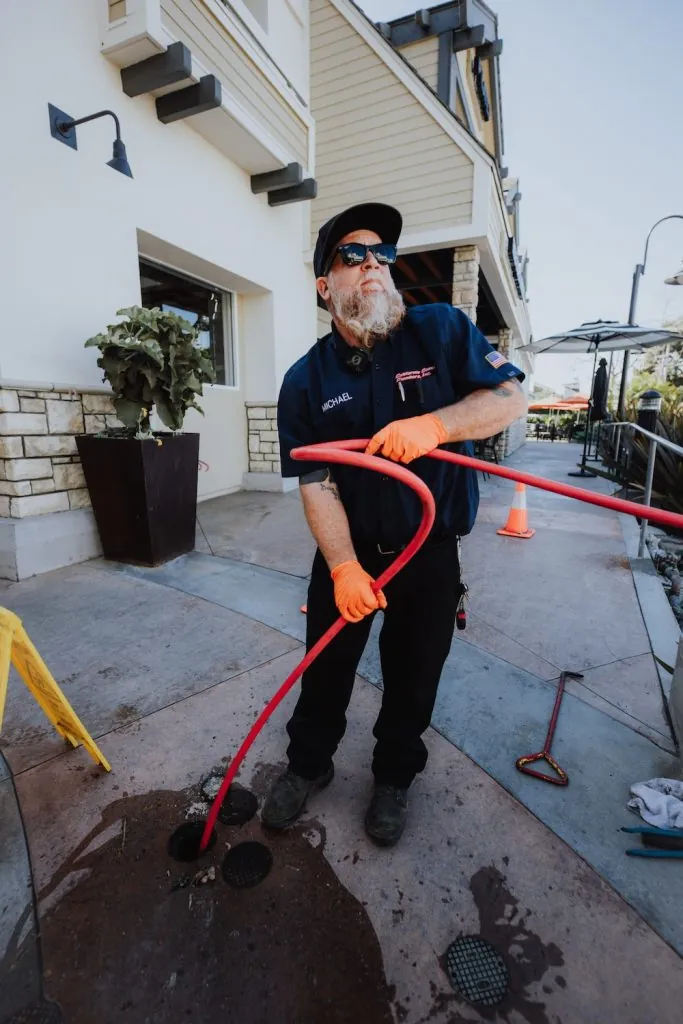
A high-pressure pump delivers water at 3,000–4,000 PSI through a specialized nozzle inserted into the drain line. The nozzle has forward-facing jets that cut through blockages and rear-facing jets that propel the hose through the line while flushing debris back toward the cleanout.
At this pressure, water doesn't just pass through the line — it strips what's adhered to the pipe wall. Grease coating, mineral scale, biological buildup, and root masses are physically removed from the interior surface.
What It Accomplishes
- Strips grease and scale coating from pipe walls — restores near-original interior diameter
- Clears the full cross-section of the line, not just the center
- Pulverizes and flushes root masses (not just cuts through them)
- Removes sediment, sludge, and debris accumulation in low-flow sections
- Produces a genuinely clean line — the basis for effective preventive scheduling
- Generates documentation of service for FOG compliance records
Important Note
- Camera inspection before jetting is standard practice on older cast iron or pipe of unknown condition — high pressure on graphitized or cracked pipe can cause damage
Commercial Maintenance Program
Yes — Primary MethodMethod 03
Chemical Cleaners
Caustic, Acid, or Enzyme-Based
Chemical drain cleaners are either alkali-based (sodium hydroxide / lye, which saponifies grease into a soap-like substance) or acid-based (sulfuric acid, which dissolves organic material). Both generate heat through an exothermic reaction and act on whatever the liquid contacts at the low point of the drain.
Enzyme and bacterial products are a third category — slower-acting, marketed as "drain maintenance" — that consume organic waste biologically over hours or days.
What It Accomplishes
- Dissolves or liquefies soft organic blockages (hair, soap, light grease) in residential or low-volume applications
- Enzyme products can reduce organic accumulation as ongoing treatment in light-use drains
What It Cannot Do
- Remove grease from pipe walls above the waterline — it only acts on what it contacts
- Clear root intrusion, scale, or mineral deposits
- Satisfy FOG compliance documentation requirements
- Serve as a compliant treatment method under OCSD, LASAN, or LA County pretreatment ordinances
Commercial Maintenance Program
Not Appropriate — See BelowSIDE BY SIDE
The Comparison at a Glance.
Every criterion that matters for commercial drain maintenance — evaluated across all three methods.
FOUR SCENARIOS — WHICH METHOD APPLIES
The Right Call Depends on the Situation.
Method selection isn't a preference — it's a function of what's happening in the line, what the property type requires, and what outcome you actually need.
What's the situation?
Emergency
Restore flow immediately with cable. Schedule hydro-jetting next business day to fully clean the line.
Preventive
Scheduled service before backup occurs. Jet on cycle — quarterly to semi-annually — and document for compliance.
Diagnostic
Recurring issue with unknown cause. Camera identifies condition — then jet, repair, or reline based on findings.
Post-Construction
Flush construction debris from full line length. Camera after jetting confirms clear condition for the new tenant.
Scenario 01 — Emergency
Tenant Reports a Sewage Backup at 10 PM
Active backup. Tenant needs the drain operational now. No time to set up jetting equipment, access may be limited, and the priority is restoring flow before any further damage occurs.
Snake First — Jet Later
Run the cable to restore flow and get the tenant operational. Schedule hydro-jetting for the next business day to actually clean the line. The snake is the emergency tool; the jet is the fix.
Scenario 02 — Preventive
Restaurant Grease Line — Quarterly Service
Full-service restaurant with high-volume kitchen. Line gets serviced on a schedule before it backs up. The goal isn't clearing a blockage — it's preventing one by removing grease accumulation before it restricts flow.
Hydro-Jetting Only
This is exactly what jetting is designed for. Camera first on first visit to document baseline condition. Jet on schedule (typically quarterly to semi-annually depending on volume). Document for FOG compliance.
Scenario 03 — Diagnostic
Office Building Drain Slow — Recurring Issue
A floor drain or fixture drain has been slow for months. Multiple snake calls haven't resolved it. The cause isn't known — it could be scale, a belly, root intrusion, or a partial collapse in a pre-1980 building.
Camera First — Then Determine
Don't snake or jet without knowing what's in the line. Run a camera inspection to identify the condition. If it's scale or grease, jet. If it's a belly or structural issue, the right repair is different entirely.
Scenario 04 — Post-Construction
New Tenant Build-Out — Line Clearing Before Occupancy
A new restaurant or commercial kitchen tenant has completed build-out. Drywall debris, construction material, and concrete dust have entered the drain lines during the project. Lines need to be cleared before equipment is connected.
Hydro-Jetting
Jetting clears the full cross-section and flushes construction debris from the entire line length. Camera after jetting confirms clear condition and establishes the baseline for the property's maintenance program going forward.
COMMERCIAL HYDRO-JETTING — SOUTHERN CALIFORNIA
In-House Equipment. High-Pressure. Every Line Documented.
California Coast Plumbers provides commercial hydro-jetting for restaurants, industrial facilities, and commercial properties across Orange County, Los Angeles County, and Riverside County. We operate in-house equipment at 3,000–4,000 PSI, pre-confirm line condition with camera when indicated, and provide documented service records for FOG compliance programs. C-36 Licensed — Lic. #736992.
We own and operate our jetting equipment. No subcontracting, no scheduling around a third party's availability.
On older pipe or unknown condition, we run the camera first — to confirm the line can handle pressure and to document what we find.
Every service visit produces a written service record. We maintain program schedules and provide documentation for sewer authority compliance audits.
Active backup? We respond on-site within 2 hours for commercial properties. Pre-qualify us before you need us.