
Commercial Water Heater Guide: Sizing, Maintenance & When to Replace.
Five system types compared, sizing guidelines by property type, a complete maintenance schedule, and a replace-vs.-repair decision framework. Built from 62,000+ commercial service calls across Southern California.
Key Takeaways
- Commercial water heaters last 8–12 years — plan for replacement, not repair, beyond year 10
- Sizing depends on fixture count and simultaneous demand, not just building square footage
- Semi-annual anode rod inspection and sediment flush are the two tasks that extend life the most
- Repair vs. replace hinges on age, efficiency loss, and whether parts are still available
WHY COMMERCIAL WATER HEATERS FAIL DIFFERENTLY
Residential Rules Don't Apply Here.
A residential water heater runs for 30 minutes in the morning and 30 minutes at night. A commercial unit in a restaurant or medical office runs nearly continuously during operating hours. That difference in duty cycle changes everything — how the system is sized, how fast components wear, what maintenance is required, and when replacement makes more financial sense than repair.
Commercial water heaters also operate under different temperature requirements. California Retail Food Code mandates 120°F at handwashing sinks and at least 140°F supply to commercial dishwashers. Medical facilities require tempered water at specific delivery points. Office buildings need to serve dozens or hundreds of fixtures from a single system. These are not the same operating conditions as a four-person household.
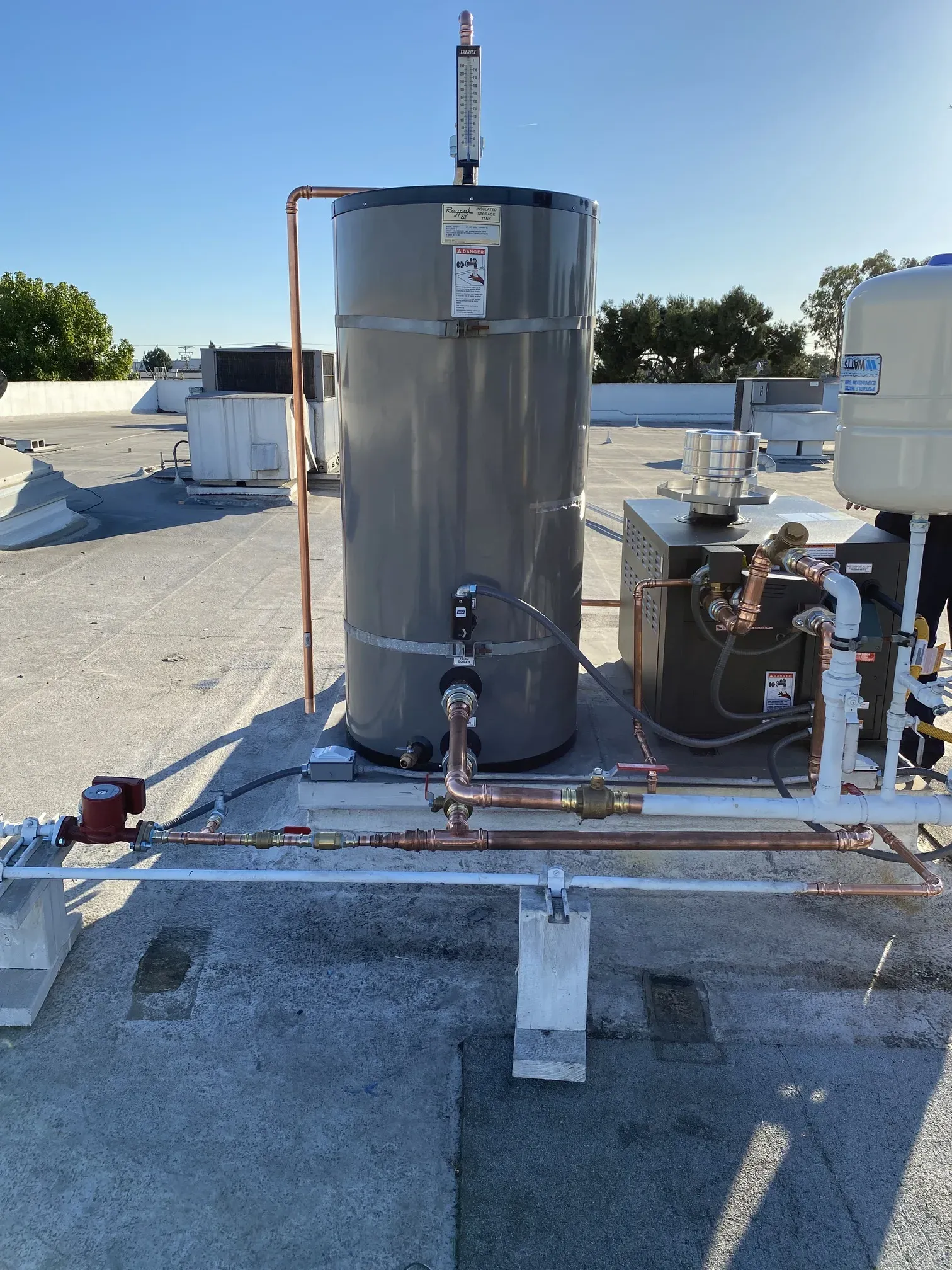
Code requirements are different, too. California commercial water heater installations require mechanical permits, seismic strapping to current standards, expansion tanks on closed-loop systems, and T&P discharge piping routed to an approved location. Many of these requirements don't apply to residential installations — and many building owners don't discover the difference until an inspection fails.
SYSTEM TYPES COMPARED
Five Commercial Water Heater Systems. What Each One Does Best.
Type 01
Commercial Storage Tank (Gas)
Most Common in Office & Retail
Typical Capacity
40–100 gallons, with recovery rates of 70–120 GPH
Best For
Office buildings, retail centers, small restaurants, mixed-use properties
Expected Lifespan
8–12 years (heavily dependent on water quality and maintenance)
Advantages
- Lowest upfront cost for commercial applications
- Fast recovery rate with atmospheric or power-vent burners
- Simple maintenance — well-understood by most plumbing contractors
- Replacement parts widely available
Limitations
- Standby heat loss — maintaining tank temperature 24/7 whether in use or not
- Anode rod and sediment maintenance required to prevent premature failure
- Physical footprint — requires dedicated mechanical space
Type 02
Commercial Storage Tank (Electric)
Where Gas Is Not Available
Typical Capacity
30–120 gallons, with recovery rates of 20–60 GPH
Best For
Tenant suites without gas service, high-rise buildings, interior spaces without venting access
Expected Lifespan
8–12 years
Advantages
- No gas line or venting required — installs in any location with electrical service
- No combustion air requirements — suitable for enclosed mechanical closets
- Lower installation cost when gas infrastructure doesn't exist
Limitations
- Slower recovery rate than gas — can struggle with continuous high demand
- Higher operating cost per BTU than natural gas in most California utility territories
- May require electrical panel upgrade for larger units (240V, 30–50 amp circuits)
Type 03
Tankless / On-Demand (Gas)
Compact, Unlimited Hot Water
Typical Capacity
No storage — delivers 5–11 GPM continuous flow, depending on unit size and temperature rise
Best For
Small offices, break rooms, point-of-use applications, properties with limited mechanical space
Expected Lifespan
15–20 years (with annual descaling in hard water areas)
Advantages
- No standby heat loss — only heats water when demand exists
- Compact wall-mount design frees floor space
- Unlimited hot water at rated flow rate — no tank to deplete
- Longer lifespan than storage tank systems
Limitations
- Higher upfront cost — unit price plus gas line upsizing and venting modifications
- Flow rate limited by unit capacity — multiple simultaneous fixtures may exceed rated GPM
- Requires annual descaling in Southern California's hard water conditions
- Not ideal for high-volume simultaneous demand (large restaurants, multiple showers)
Type 04
Heat Pump / Hybrid
Energy Efficient, Slower Recovery
Typical Capacity
50–80 gallons, with heat pump recovery of 10–30 GPH (hybrid mode uses electric backup for faster recovery)
Best For
Properties pursuing energy efficiency, buildings with warm ambient mechanical rooms, Title 24 compliance projects
Expected Lifespan
10–15 years
Advantages
- 60–70% less energy consumption than standard electric resistance
- Qualifies for utility rebates and Title 24 energy compliance credits
- Dehumidifies and cools the mechanical room as a byproduct
Limitations
- Slow recovery in heat pump mode — not suited for continuous high-demand applications
- Requires warm ambient air (40–90°F) — underperforms in cold or confined spaces
- Higher upfront cost than standard electric tank
- Compressor noise may be a factor in certain locations
Type 05
Boiler-Fed System
Large Buildings, Central Plant
Typical Capacity
Central boiler producing 200–1,000+ gallons of stored hot water via indirect storage tanks or heat exchangers
Best For
Hotels, hospitals, large multi-tenant buildings, campuses with centralized mechanical plants
Expected Lifespan
20–30 years for the boiler; 10–15 years for indirect storage tanks and heat exchangers
Advantages
- Highest capacity — serves hundreds of fixtures from a single plant
- Can also serve hydronic heating loops from the same boiler
- Extremely high recovery rate — meets sustained peak demand
- Long equipment life with proper water treatment and maintenance
Limitations
- Highest capital cost — boiler, storage tanks, circulation pumps, controls
- Requires licensed boiler operator or maintenance contractor
- Complex water treatment program to prevent scaling and corrosion
- Large mechanical room footprint
8–12 yrs
Average commercial water heater lifespan. Beyond year 10, repair costs accelerate and efficiency drops. Plan the replacement — don't wait for the failure.
SIZING BY PROPERTY TYPE
Recovery Rate Matters More Than Tank Size.
Most undersized commercial water heater installations happen because someone specified by tank volume alone. A 100-gallon tank with a 40 GPH recovery rate will run out of hot water faster than a 75-gallon tank with an 80 GPH recovery rate during sustained peak demand. The sizing calculation that matters is peak hour demand — the maximum gallons of hot water needed during the busiest 60-minute window of the day.
MAINTENANCE SCHEDULE
What to Check and When. Three Cadences for Commercial Water Heaters.
In-house team or building engineer — visual inspections and basic checks
Visual Inspection
External Condition Check
- Look for water pooling at the base of the unit — any standing water is a warning
- Check supply and return line connections for active drips or mineral deposits
- Inspect the area around the unit for scorch marks, soot, or unusual odors (gas units)
- Verify pilot light or electronic ignition is operating normally
Operating Parameters
T&P Discharge & Temperature Verification
- Check T&P (temperature and pressure) relief valve discharge pipe for signs of active dripping or mineral buildup
- Verify thermostat setting: 120°F for domestic use, 140°F for food service dishwashers
- Run hot water at the furthest fixture — verify temperature reaches setpoint within expected time
- Listen for unusual sounds: popping (sediment), whistling (pressure), or rumbling (scale buildup)
Professional plumber recommended — requires tools and expertise
Tank Internals
Anode Rod & Sediment Flush
- Inspect sacrificial anode rod — replace if less than 50% of original diameter remains
- Flush sediment from tank bottom through drain valve until water runs clear
- In Southern California hard water areas, sediment flush may need to be quarterly
- Check dip tube for deterioration (broken dip tubes cause lukewarm water at full fixtures)
Safety & Expansion
Expansion Tank & Relief Valve
- Check expansion tank pre-charge pressure — should match incoming water pressure
- Verify expansion tank bladder has not failed (tap tank — full water sound means replacement)
- Manually lift T&P valve lever to verify discharge, then reseat
- Inspect T&P discharge pipe routing — must terminate at an approved location (6 inches above floor or to exterior)
Licensed contractor required — full professional service
Full System Service
Comprehensive Professional Inspection
- Complete sediment drain and tank flush
- Replace anode rod if degraded beyond service threshold
- Test and verify thermostat accuracy against actual delivered temperature
- Inspect and clean burner assembly (gas units) — check flame pattern and combustion
- Test gas connection with electronic leak detector (gas units)
- Inspect heating elements for scale buildup (electric units)
Venting & Code Compliance
Gas Connection, Venting & Safety
- Inspect flue and venting for proper draft, clearance, and termination (gas units)
- Verify combustion air supply is adequate and unobstructed
- Check seismic strapping — must be secured per current California code
- Verify expansion tank, T&P valve, and discharge pipe are to code
- Document unit age, serial number, and remaining estimated service life
- Provide written report with condition assessment and any recommended actions
WARNING SIGNS
Six Signs It's Time to Replace — Not Repair.
Not every water heater problem is a repair. Some failures indicate the system is past the point where additional investment makes financial sense. Here are the conditions that typically signal replacement.
Age Threshold
Unit Is Over 10–12 Years Old
Commercial storage tank water heaters have a typical service life of 8–12 years. Beyond that window, component failures accelerate and efficiency drops measurably. A unit at year 11 with a $1,200 repair bill is almost always a replacement candidate.
Pattern Indicator
Repeated Repairs in 12 Months
A single thermocouple replacement is maintenance. Two or three service calls in a year for different components — thermocouple, gas valve, element, T&P valve — means the system is failing systemically, not just in one part.
Structural Failure
Tank Leaking at the Base
Water at the base of a storage tank water heater (not from the T&P valve or fittings) means the tank liner has corroded through. This is not repairable. The tank has failed structurally and replacement is the only option.
Efficiency Loss
Rising Energy Costs, Same Usage
- Gas or electric bills increasing without usage changes
- Scale buildup on heating elements or heat exchanger reducing thermal transfer
- Sediment insulating the tank bottom from the burner
Water Quality
Rust-Colored or Metallic Water
- Discolored hot water (cold runs clear) indicates internal tank corrosion
- Anode rod is depleted — the tank lining is now corroding directly
- Once visible rust appears in the water, the damage is irreversible
Performance Failure
Inconsistent Temperature
- Temperature swings during normal use indicate failing thermostats or elements
- Hot water runs out faster than it used to — sediment has reduced effective tank volume
- Water never reaches setpoint — burner or element degradation
DECISION FRAMEWORK
Repair vs. Replace: A Cost Comparison.
The decision isn't just about what the repair costs today. It's about what you'll spend over the next 24 months. A $600 repair on a 12-year-old unit that needs another $800 repair six months later is more expensive than replacing the system once.
Repair Makes Sense When
The Math Still Works.
- Unit is less than 8 years old
- First repair in the current year
- Issue is a single component — thermocouple, gas valve, element, or T&P valve
- Repair cost is less than 50% of replacement cost
- Tank shows no signs of internal corrosion (clear hot water, no base leaks)
- Energy efficiency has not noticeably declined
Typical Repair Range
$200 – $1,200
Replace Makes Sense When
The Repair Is Just Buying Time.
- Unit is over 10 years old
- Second or third repair in 12 months
- Tank is leaking at the base (structural failure — not repairable)
- Rust-colored hot water that persists after flushing
- Repair cost exceeds 50% of replacement cost
- Energy costs have increased without usage changes
- Unit no longer meets current code (seismic strapping, expansion tank, venting)
Typical Replacement Range (Installed)
$3,500 – $8,000+
CALIFORNIA CODE REQUIREMENTS
Permits and Code for Commercial Water Heater Installation.
California commercial water heater installations are not like-for-like swaps. Even a straightforward replacement can trigger code upgrade requirements if the original installation predates current standards. Here's what's required.
- Mechanical permit required. All commercial water heater installations in California require a mechanical permit from the local jurisdiction. The installer must hold a valid C-36 plumbing license. Permit fees vary by jurisdiction but typically range from $75 to $250.
- Seismic strapping to current code. California requires all water heaters to be seismically strapped. Commercial installations must meet current CPC (California Plumbing Code) standards — even if the original unit was installed before these requirements existed.
- Expansion tank on closed-loop systems. If the building has a backflow prevention device on the water supply (most commercial properties do), the system is closed-loop. Thermal expansion must be managed with an appropriately sized expansion tank. This is code — not optional.
- T&P relief valve and discharge piping. The temperature and pressure relief valve must discharge through a pipe that terminates no more than 6 inches above the floor or to an approved exterior location. The discharge pipe cannot be reduced in size, threaded at the termination, or routed upward.
- Venting and combustion air (gas units). Gas-fired water heaters must vent to the exterior through approved materials (Type B vent for natural draft, stainless for power vent). Combustion air supply must meet current code minimums — which are often larger than what was required when the original unit was installed.
- Gas line sizing verification. Replacing a water heater with a higher-BTU unit may require upsizing the gas supply line. This must be verified against the total connected load on the gas meter and the length of run from the meter to the unit.
- Title 24 energy compliance. New commercial water heater installations must meet California Title 24 energy efficiency standards. High-efficiency units, heat pump systems, or solar preheat may be required depending on building type and climate zone.
- Final inspection. After installation, a city or county inspector will verify the installation against the permit. Gas connections, venting, seismic strapping, expansion tank, T&P discharge, and electrical connections are all inspected. Failing inspection means corrections and re-inspection — which means additional cost and delay.